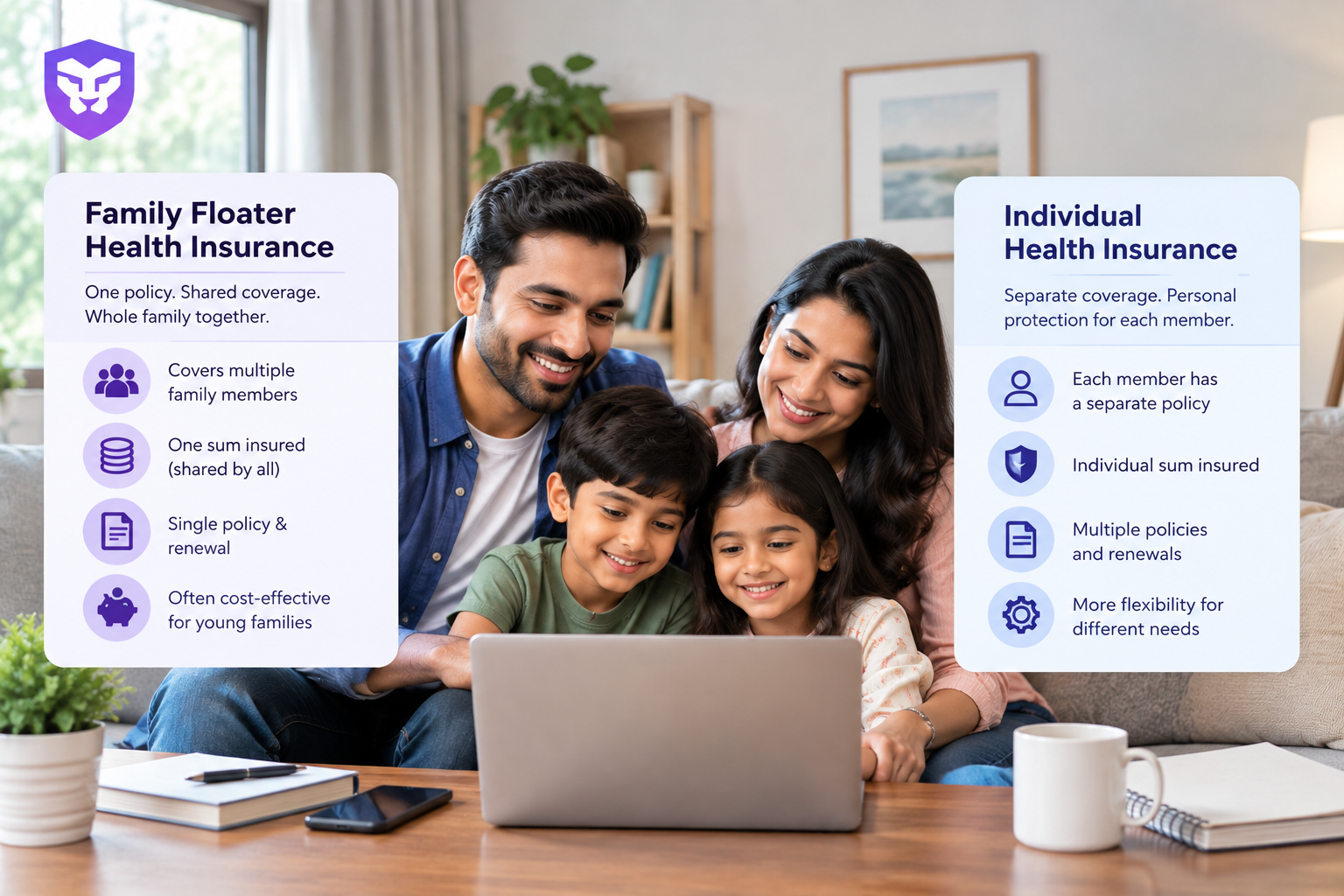
Quick Answer: Family Floater or Separate Health Insurance?
If you are married with children, the right choice depends on your family's age, health needs, budget and required coverage.
A family floater is often suitable for a young and healthy family because everyone shares one sum insured under a single policy.
Separate individual health insurance may be better when family members have different healthcare needs or when you want each person to have independent coverage.
For many families, a combination also works well:
- Family Floater: Husband + Wife + Children
- Separate Health Insurance: Parents
The best health insurance in India is not simply the cheapest policy. It should provide sufficient coverage when your family actually needs medical treatment.
What Is a Family Floater Health Insurance Policy?
A family floater covers multiple family members under one policy with a shared sum insured.
For example, suppose a family has a ₹10 lakh policy covering:
- Husband
- Wife
- Two children
The ₹10 lakh is shared by all covered members according to the policy terms.
If one family member uses ₹4 lakh for an eligible claim, the remaining available coverage may be ₹6 lakh for the policy year, subject to policy conditions and restoration benefits.
The most important point:
₹10 lakh is shared coverage—it is not ₹10 lakh separately for every family member.
What Is Individual Health Insurance?
With Individual Health Insurance in India, every insured person has their own separate sum insured.
For example:
- Husband: ₹10 lakh
- Wife: ₹10 lakh
- Child: ₹5 lakh
A claim made by one person generally does not reduce another person's separate coverage.
This can provide stronger individual protection, although the total premium may be higher than a family floater.
Family Floater vs Individual Health Insurance: Comparison
| Feature | Family Floater | Individual Health Insurance |
|---|---|---|
| Coverage | Shared | Separate for each person |
| Sum Insured | One common amount | Individual amount |
| Premium | Often economical for young families | May cost more overall |
| Policy Management | One policy | Multiple policies |
| Flexibility | Suitable for similar needs | More personalised |
| Large Claim | Can reduce shared coverage | Usually does not affect others |
| Best For | Young, healthy families | Different healthcare needs |
Important: Premiums and benefits vary by insurer and policy.
Why Do Families Choose a Family Floater?
1. Easier to Manage
Instead of maintaining multiple policies, you may have:
- One renewal date
- One policy document
- One insurer
- One premium payment
This makes policy management simpler.
2. Can Be Cost-Effective
A family floater can sometimes cost less than buying separate policies for every family member, especially for younger and relatively healthy families.
However, don't assume a floater is always cheaper.
Premiums depend on factors such as:
- Age
- Number of family members
- Sum insured
- Medical history
- Location
- Policy benefits
Always compare actual policy quotes and coverage.
3. Flexible Use of Coverage
The shared sum insured can be used by the family member who needs it.
For example, if your family has ₹15 lakh coverage and one child requires treatment costing ₹2 lakh, the policy can be used for that eligible expense according to its terms.
Disadvantages of a Family Floater
1. The Sum Insured Is Shared
This is the biggest limitation.
If one member makes a large claim, the remaining coverage available to other members may be reduced.
For example:
₹10 lakh family floater
If one member uses ₹8 lakh, only ₹2 lakh may remain during that policy year, subject to policy terms and restoration benefits.
2. Older Members May Increase Costs
Adding older parents to the same family floater may increase premiums and may not always provide the most suitable coverage structure.
Families should compare a separate Health Insurance for Parents in India policy, especially when parents have different healthcare requirements.
Should I Include My Parents in My Family Floater?
There is no single answer for every family.
Consider comparing these options:
Option 1: One Policy for Everyone
One family floater covering you, your spouse, children and parents.
Option 2: Separate Parents' Coverage
Family floater for:
Husband + Wife + Children
Separate health insurance for:
Parents
Option 3: Individual Policies
Separate coverage for family members with significantly different healthcare needs.
For many families, keeping parents on separate coverage can provide greater flexibility. Before deciding, compare:
- Premium
- Eligibility
- Waiting periods
- Co-payment
- Coverage
- Exclusions
- Hospital network
Is a Family Floater Good for Children?
A family floater can be convenient for families with young children.
When choosing health insurance for children in India, check:
- Child eligibility
- Hospitalisation coverage
- Day-care treatment
- Waiting periods
- Network hospitals
- Room-rent conditions
- Exclusions
- Newborn coverage, if required
Always check the policy wording because child and newborn eligibility can vary.
What Should Families Consider for Women's Health Insurance?
When comparing health insurance for women in India, consider the family's specific healthcare requirements.
Important features may include:
- Hospitalisation coverage
- Maternity benefits
- Maternity waiting period
- Newborn coverage
- Day-care treatment
- Network hospitals
If you are planning to have children, check Maternity Health Insurance in India well in advance because maternity benefits may have waiting periods and eligibility conditions.
When Is a Family Floater a Good Choice?
A family floater may be suitable when:
- Both spouses are relatively young
- Children are young
- Family members are generally healthy
- You prefer one policy
- You are comfortable with shared coverage
- The sum insured is sufficient
- The premium fits your budget
For many young families, a family floater can provide simple and practical health protection.
When Should You Consider Separate Health Insurance?
Separate policies may be more suitable when:
One Member Has Higher Healthcare Needs
If one person is likely to require frequent or expensive medical treatment, independent coverage may provide better protection.
Parents Are Older
Older parents often have different healthcare needs and may benefit from separate coverage.
You Want Independent Protection
One person's claim generally does not reduce the separate sum insured for another person.
Family Members Need Different Benefits
For example, one person may need maternity benefits while another may require higher coverage for age-related healthcare needs.
How Much Family Health Insurance Do You Need?
There is no fixed amount that is right for every family.
When choosing Family Health Insurance in India, consider:
- Number of family members
- Age of each member
- City and local hospital costs
- Existing employer insurance
- Medical history
- Savings and financial responsibilities
- Future healthcare needs
Don't choose coverage based only on the lowest premium.
Ask yourself:
Would this amount provide meaningful financial protection if two family members required treatment in the same year?
What Should You Check Before Buying Health Insurance?
Whether you choose a family floater or individual policies, check these points carefully.
Sum Insured
Is the coverage sufficient for your family's healthcare needs?
Waiting Period
Check waiting periods for pre-existing conditions and specified treatments.
Co-Payment
Understand whether you must pay part of eligible medical expenses.
Deductible
Check how much you may need to pay before certain policy benefits apply.
Room-Rent Limits
Look for room-rent or ICU restrictions.
Sub-Limits
Some policies may limit coverage for particular treatments.
Cashless Hospitals
Check whether the hospitals your family is likely to use are in the network.
Restoration Benefit
Some policies may restore the sum insured after it is used, subject to specific conditions.
Renewal Terms
Understand long-term renewal and continuity benefits.
What Is Cashless Health Insurance?
Cashless Health Insurance in India generally allows eligible hospital expenses to be settled directly between the insurer or TPA and a network hospital, subject to approval and policy conditions.
Before buying, check whether useful hospitals are available near:
- Your home
- Your workplace
- Your children's school area
- Areas you frequently travel to
A large hospital network is useful, but access to hospitals that are actually convenient for your family matters more.
How to Compare Health Insurance Plans in India
Don't compare policies based only on premium.
When you compare health insurance plans in India, check:
| What to Compare | Question to Ask |
|---|---|
| Premium | Can you afford it long term? |
| Sum Insured | Is it enough for your family? |
| Coverage | What medical expenses are covered? |
| Waiting Period | How long must you wait? |
| Co-payment | How much might you pay? |
| Deductible | When does it apply? |
| Room Rent | Are there restrictions? |
| Hospitals | Are preferred hospitals included? |
| Maternity | Is it required? |
| Parents | Do they need separate coverage? |
| Renewal | Can coverage continue long-term? |
This approach is more useful than simply searching for the best health insurance plans in India.
How to Buy Health Insurance Online in India
If you plan to buy health insurance online in India, follow these steps.
Step 1: List Everyone You Want to Cover
Include:
- Spouse
- Children
- Parents, if applicable
Step 2: Check Age and Health Details
Age and medical history can affect eligibility and premiums.
Step 3: Decide Your Coverage Requirement
Estimate the financial protection your family may realistically need.
Step 4: Compare Multiple Policies
Compare benefits, exclusions and limits—not only price.
Step 5: Check the Policy Wording
Review waiting periods, exclusions and conditions before purchasing.
Step 6: Verify Cashless Hospitals
Check hospitals in your local area.
Can a Health Insurance Premium Calculator Help?
A health insurance premium calculator in India can help estimate premiums based on factors such as:
- Age
- Number of members
- Sum insured
- Policy type
It is useful for budgeting.
However, the cheapest policy is not automatically the best policy.
Compare the premium with:
- Coverage
- Exclusions
- Waiting periods
- Co-payment
- Deductibles
- Hospital network
What If I Already Have Employer Health Insurance?
Employer health insurance can be useful, but check what it actually provides.
Review:
- Sum insured
- Family coverage
- Parents' coverage
- Maternity benefits
- Network hospitals
- Co-payment
- Coverage after changing jobs
Employer insurance can complement your personal insurance, but relying only on employer coverage may not always provide long-term protection.
Should You Consider Critical Illness or Other Covers?
Regular health insurance and critical illness insurance in India serve different purposes.
A regular health policy generally covers eligible medical expenses according to policy terms.
A critical illness policy may provide a defined benefit after diagnosis of a covered illness, subject to policy conditions.
You may also evaluate:
- Accident Insurance in India
- OPD Health Insurance in India
- Top-up Health Insurance in India
These should generally be considered based on your family's specific financial and healthcare needs.
What Is Top-Up Health Insurance?
If your base coverage is not sufficient, Top-up Health Insurance in India may provide additional protection above a specified deductible, subject to policy terms.
Before buying, understand:
- Deductible
- Additional coverage
- Waiting periods
- Exclusions
- How the top-up interacts with your base policy
Family Floater vs Individual Policies: Simple Example
Imagine a family of four:
- Husband: 35
- Wife: 33
- Child: 7
- Child: 4
Option A: Family Floater
₹15 lakh shared coverage for the family.
Option B: Separate Policies
- Husband: ₹10 lakh
- Wife: ₹10 lakh
- Children: Separate coverage according to their needs
Which Is Better?
There is no automatic winner.
A family floater may offer simplicity and potential cost advantages for a young and healthy family.
Separate policies may offer stronger independent protection when family members have different healthcare needs.
Simple Decision Guide
Choose a Family Floater If:
- You have a young family
- Members are generally healthy
- You prefer one policy
- You are comfortable sharing the sum insured
- Coverage is sufficient for your family
Consider Separate Policies If:
- A member has significantly higher healthcare needs
- Parents are older
- You want independent coverage
- Family members need different benefits
Consider a Combination If:
You have a young family and older parents.
A structure worth comparing is:
Family Floater → Husband + Wife + Children
Separate Health Insurance → Parents
This can allow coverage to be selected according to each group's healthcare requirements.
Common Mistakes Families Should Avoid
Choosing Only the Cheapest Policy
Low premium does not always mean suitable coverage.
Ignoring the Shared Nature of a Floater
One large claim may reduce the coverage available to other members.
Assuming Everything Is Covered
Waiting periods, exclusions, deductibles and limits may still apply.
Automatically Adding Parents
Parents may need separate coverage because of different healthcare needs.
Ignoring Maternity Waiting Periods
Check maternity conditions early if you are planning a family.
Not Checking Cashless Hospitals
Always verify hospitals your family can realistically access.
Frequently Asked Questions
Is a family floater better than individual health insurance?
Not always. A family floater can be suitable for young and healthy families, while individual policies provide separate coverage for each person. The right choice depends on your family's healthcare needs.
What is the main difference between family floater and individual health insurance?
A family floater has a shared sum insured for covered members. Individual health insurance provides separate coverage for each insured person.
Is a family floater cheaper?
It can be more economical for younger families, but premiums depend on age, health profile, coverage and policy features.
Should I include my parents in my family floater?
Compare carefully. Older parents may have different healthcare needs and may benefit from separate health insurance.
Is a family floater good for children?
It can be convenient for young children, provided the policy offers suitable eligibility and coverage.
Can I buy family health insurance online?
Yes. You can research and buy policies online, but always review policy wording, exclusions, waiting periods and hospital networks before purchasing.
Can I have both a family floater and individual health insurance?
Yes. Depending on your needs, families may use a floater for their core family and separate policies for parents or members with different healthcare requirements.
Final Takeaway
If you are married with children, choosing between a family floater and separate health insurance should depend on your family's actual healthcare and financial needs.
A family floater may be a good option when:
- Your family is young
- Members are relatively healthy
- You want simple policy management
- Shared coverage is sufficient
Separate health insurance may be better when:
- Family members have different healthcare needs
- Parents are older
- You want independent coverage
For many families, a combination can also make sense:
Family Floater for Husband + Wife + Children
Separate Health Insurance for Parents
Before choosing a policy, compare:
Sum Insured + Coverage + Waiting Period + Exclusions + Co-payment + Hospital Network + Renewal + Premium
The goal is not simply to find the cheapest health insurance policy.
The goal is to choose coverage that can provide meaningful financial protection when your family actually needs medical care.